Georgina Bondfield | 18 November 2026
Commercial property lease commitments remain significantly shorter than before the pandemic, but the latest movements reveal a more complex picture.
Re-Leased's Q3 2026 Market Lens research shows that average lease lengths across office, industrial and retail property in Australia, New Zealand and the UK remain at least 31% below Q3 2019 levels.
Yet not every market is moving in the same direction. UK office and New Zealand industrial lease terms increased year on year, while retail commitments continued to shorten across all three countries.
For landlords, the implications extend beyond individual lease lengths. Shorter commitments can bring forward the next negotiation, renewal or reletting decision, increasing the frequency with which rental income needs to be secured.
The question is not simply whether leases are getting shorter. It is how soon income needs to be secured again, and what that next decision could cost.
Across global property markets, occupiers are balancing their need for quality space with the costs and risks of longer-term commitments.
JLL's November 2026 Global Real Estate Perspective highlights resilient occupier demand, even as businesses contend with rising rents, operating costs and economic uncertainty. Global office leasing increased 5% year on year in Q3, with total leasing volumes for the first nine months of 2026 reaching a new post-pandemic peak.
Strong leasing activity and a preference for flexibility are not necessarily contradictory. Businesses still need space, but the terms on which they are prepared to commit can change as their requirements and economic conditions evolve.
Our latest retail findings illustrate how differently those commitments are changing across markets.
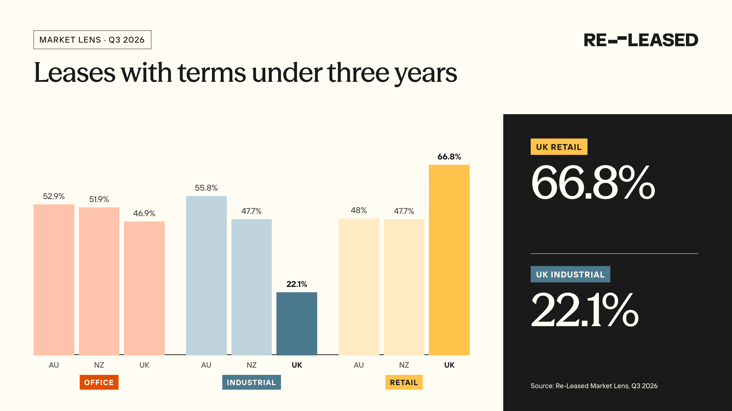
In the UK, 66.8% of retail lease terms starting in Q3 2026 were under three years, compared with 48% in Australia. The UK saw a particularly strong shift towards one-to-three-year agreements, while New Zealand recorded a sharp increase in terms under twelve months, from 7.9% a year earlier to 17.6%.
These distinctions matter. A lease lasting less than twelve months creates a very different income horizon from one lasting three years, even though both fall within the broader category of shorter commitments.
Shorter leases should not automatically be interpreted as weakening occupier demand. They can reflect a range of commercial considerations, from changing space requirements to a preference for greater flexibility.
A shared shift towards shorter commitments does not mean markets are experiencing the same conditions, or that occupiers are making those decisions for the same reasons.
The differences become even clearer when we look at office and industrial property.
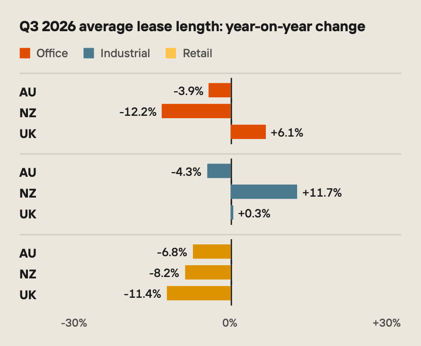 In the UK, average office lease length rose 6.1% year on year in Q3 2026. Australia moved in the opposite direction, with average office terms declining, while New Zealand also recorded a year-on-year fall despite a quarterly recovery.
New Zealand's industrial sector presented a different picture. Average lease length increased 11.7% year on year, even as the share of terms under three years rose from 42.2% to 47.7%.
This illustrates why averages alone can be misleading. Longer average lease terms can coexist with a growing proportion of shorter agreements, depending on the mix of leases commencing in the quarter.
For landlords, understanding that mix is important when assessing how the income horizon across a portfolio may change over time.
The longer-term context also matters. Despite the recent improvement, the UK's average office lease length remained 36.9% below Q3 2019. New Zealand office terms were also substantially below their pre-pandemic levels.
A recent increase is not the same thing as a return to an earlier commitment horizon.
For landlords, the implications of shorter commitments are practical.
If shorter lease terms become a sustained feature of the market, landlords could face more frequent renewal, negotiation and reletting decisions over time. Across a portfolio, that means more occasions when tenant retention, rental income and the cost of securing the next period of occupancy need to be considered.
But the risks are not uniform. A portfolio with a high proportion of shorter leases may still have strong tenant demand and retention. Equally, longer average lease terms do not necessarily eliminate exposure if significant rental income is concentrated around a small number of upcoming expiries.
This is why understanding the mix of lease terms, upcoming expiries and the income attached to them matters as much as tracking average lease length.
Landlords need to know where income is approaching a decision point, what it may take to retain an existing tenant and how the cost of reletting compares with renewal.
Shorter leases do not automatically mean weaker income. But they can reduce the time available to prepare for the next decision.
As lease commitments evolve, the strength of a commercial property portfolio will depend not just on how long income is contracted for, but on how effectively owners prepare for the moments when that income needs to be secured again.
Sources