
Lease Management Software: The Ultimate Guide to Lease and Tenant Management in 2026
by Dulan Perera
Director, Growth
Updated 6 May 2026


Contents
Key Takeaways What is Lease Management, Lease Administration, and Tenant Management? What lease types should you use by asset class? What are the legal and compliance fundamentals for lease management? What standard workflows and internal controls do you need? How do you approach lease abstraction and metadata standards? How does lease management software improve operations? What tenant management strategies increase renewals?Key Takeaways
- Separate strategy from execution. Lease management sets portfolio strategy, lease administration executes data accuracy and billing, and tenant management builds relationships that drive renewals.
- Match lease structures to asset strategy. Gross, modified gross, NNN, percentage, and ground leases each carry different risk profiles, admin complexity, and technology requirements.
- Automate critical dates. Implement 90-60-30-15 day alerts tied to owners, managers, and legal teams to prevent missed renewals, options, and escalations.
- Invest in lease management software. Teams using centralized platforms report 3-7% revenue uplift, 25-30% admin time savings, and 50-70% faster CAM reconciliation cycles.
- Use AI to accelerate lease abstraction. AI-powered extraction reduces weeks of manual data entry to hours while maintaining 95%+ accuracy with human-in-the-loop QA.
What is Lease Management, Lease Administration, and Tenant Management?
Lease management is the strategic oversight of lease terms, renewals, and risk across a commercial portfolio. Lease administration handles execution: data accuracy, billing, compliance workflows. Tenant management focuses on relationships, from screening and onboarding through maintenance SLAs and renewal outreach. Together, these three functions form the operational backbone of any commercial property business.
Clear role definitions reduce errors and speed cycles across the lease and tenant lifecycle. At scale, small misses can turn into real leakage.
Lease management provides strategic oversight across the lease lifecycle. It governs acceptable terms, manages critical dates, and aligns portfolio decisions with investment goals. It also ensures compliance with accounting standards like ASC 842 and IFRS 16
Lease administration on the other hand focuses on execution. Teams abstract data, maintain a single source of truth, bill per contract, process amendments, and coordinate with accounting.
Tenant management drives renewals through screening, onboarding, communication, maintenance SLAs, and community-building. Strong relationships raise satisfaction and reduce churn.
How These Functions Work Together Across Portfolios
One renewal often touches all three functions. Lease management sets the rent strategy. Lease administration tracks the option window and prepares the amendment. Tenant management nurtures the relationship to secure an on-time signature. Unified dashboards and role-based workflows streamline handoffs.
3.png?width=401&height=385&name=Maintenance-Calendar----no-bg-1-2-(1)3.png)
What lease types should you use by asset class?
Lease structure sets risk allocation, cash flow timing, admin effort, and tenant experience. The choice of which lease type works best depends on asset strategy, market norms, and team capacity.
Gross vs. Modified Gross vs. Triple Net (NNN) Leases
Gross leases offer tenant cost predictability. Landlords carry operating expense risk and need sound forecasting and escalation clauses.
Modified gross leases split the difference. A base year is set, and tenants pay increases above that base for categories like taxes and utilities. Careful clause drafting and tracking are essential.
Triple net (NNN) leases pass taxes, insurance, and Common Area Maintenance (CAM) to tenants. This can stabilise owner income but requires precise expense allocation and annual true-ups.
Percentage and Ground Leases in Practice
Percentage leases tie rent to sales above a breakpoint. They align interests but demand rigorous sales reporting and audit procedures.
Ground leases grant long-term control over improvements while the landowner retains fee title. They require close monitoring of development milestones and end-of-term provisions.
Comparison of lease types
| Lease Type | Landlord Risk | Tenant Predictability | Admin Complexity | Best Fit Assets |
|---|---|---|---|---|
| Gross | Higher (expenses) | High | Low–Medium (escalations) | Residential, small office |
| Modified Gross | Shared (base year) | Medium–High | Medium (allocation tracking) | Office, multi-tenant |
| NNN | Lower (pass-through) | Variable | High (CAM true-up) | Retail, industrial |
| Percentage | Tied to sales | Variable | High (sales audits) | Retail centers |
| Ground | Long-term oversight | Long-term control | High (development covenants) | Mixed-use, institutional |
For a deeper dive on the different types of commercial leases you can take a look at our guide linked below.
What are the legal and compliance fundamentals for lease management?
Compliance failures are costly. To prevent these it is important to standardise processes and documentation factoring in your jurisdiction.
Security Deposits, Disclosures, and Eviction Procedures
Deposit amounts, escrow or interest, timelines, and return rules vary by state. Build jurisdictional checklists and document deductions thoroughly.
Disclosures (rights, conditions, ownership) and eviction procedures (notice periods, mediation) are increasingly prescriptive. Follow step-by-step workflows and maintain an auditable record.
Data Privacy and Audit Trails in Lease Administration
Protect tenant PII and financials with access controls, encryption, and breach response plans. Maintain audit trails for edits, approvals, and document versions.
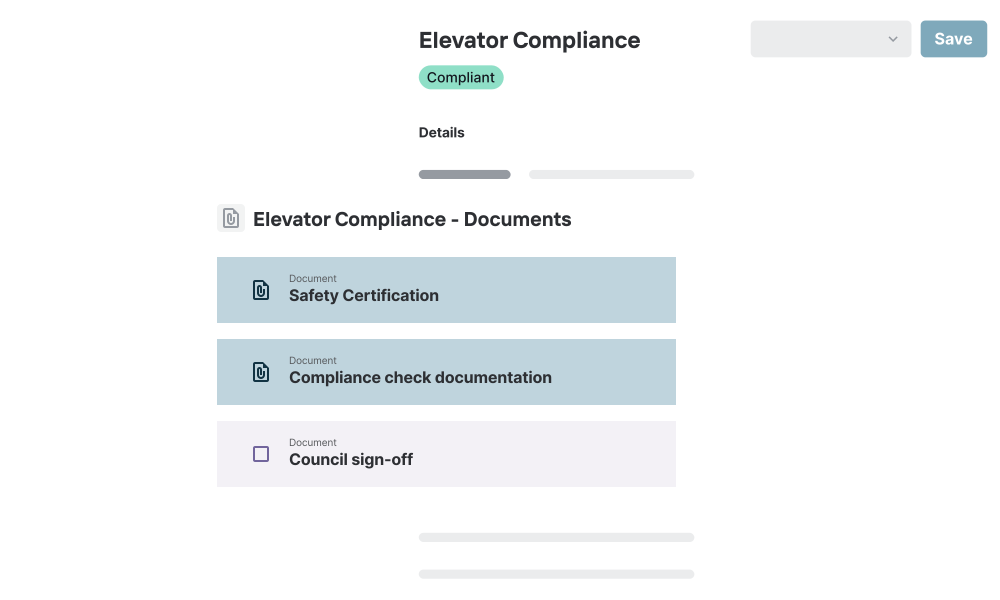
What standard workflows and internal controls do you need?
Consistent workflows and controls prevent missed revenue, speed collections, and reduce disputes. Here are a some essential controls you want to put in place across the different stages of the lease lifecycle.
Pre-Lease and Screening
- Market analysis: comp rents, term and TI benchmarks, vacancy outlook, and renewal probability.
- Screening standards: credit and income, rental and trade references, and business financials for commercial. Document decisions for compliance.
Lease Execution and E-Signature
- Document QC: verify economics, options, escalation mechanics, insurance, and use clauses against policy.
- Collect deposits and COI, execute with e-signature, and store with version control.
Critical Dates, Rent Escalation, and Expense Recovery
- Set alerts at 90–60–30–15 days for renewals, options, and escalations. Alert ladders like these prevent the most costly misses.
- Escalations: automate CPI and fixed steps per formula. Retain index snapshots with calculations.
- Expense recovery: codify allocation methods (pro rata, usable, caps or floors). Run annual CAM true-ups on a published timeline with transparent packets.
Amendments, Renewals, and Terminations
- Amendments: require approvals, financial impact analysis, and versioned documentation with audit trails.
- Renewals: begin analysis 12–18 months for commercial or 90–120 days for residential. Align pricing to market and condition, and engage early with tenants.
The most effective way to ensure you cover all these areas is with adequate checklists in your software stack. As a starting point you can also leverage our free Lease Administration Checklist Tool below.
How do you approach lease abstraction and metadata standards?
Clean, consistent data powers billing accuracy, alerts, budgeting, reporting, and analytics. This makes it very important that you abstract critical fields of lease documents. These fields include:
- Parties
- Premises
- Term
- Rent schedule
- Escalations (CPI, fixed, steps)
- Operating expense responsibilities,
- Options (renewal, termination, ROFR, ROFO)
- Insurance
- Maintenance,
- Exclusives
- Co-tenancy
- Percentage rent
- Critical dates
Its important to target 95%+ accuracy on all these critical data points. Use two-tier QA (analyst and supervisor) and periodic audits to ensure the abstraction is performing up to expectation.
Lease abstraction is accelerating with OCR and AI. It is still however important to keep humans in the loop for complex provisions and exceptions. In the abstraction process it's also important to maintain traceability back to the signed source.
How does lease management software improve operations?
Software translates policy into consistent execution at scale with audit-ready evidence.
Must-have capabilities for lease management software include integrated workflows, complex calculations (percentage rent and multi-tier escalations) and role-based access.
Outside of these there are some very useful features Re-Leased offers such as:
| Capability | Why It Matters | Re-Leased Approach |
|---|---|---|
| Critical Date Alerting | Prevents missed renewals and options | 90-60-30-15 day cascading alerts with approval routing |
| CAM/OPEX Automation | Eliminates manual allocation errors | Import GL, allocate per lease terms, produce tenant packets automatically |
| Lease Abstraction | Reduces onboarding time for new properties | Credia Extract uses AI to extract key data from lease documents |
| Portfolio Dashboards | Real-time visibility across all assets | Re-Leased Insights with occupancy, income, arrears, and maintenance KPIs |
| Accounting Integration | Eliminates double-entry and reconciliation errors | Two-way sync with Xero, QuickBooks, Sage Intacct, and NetSuite |
| Mobile Access | Enables field-based operations | Property manager, tenant, and landlord mobile apps |
Evaluate vendors on data model flexibility, integration depth, security posture, and time to value.
What tenant management strategies increase renewals?
Retention is the most efficient path to NOI growth. Replacements often cost more than targeted retention investments. The key to long term retention lives at different stages of the lease lifecycle. These are a few of the key strategies:
- Screening: apply consistent, criteria-based decisions while maintaining local compliance standards.
- Onboarding: perform condition reports, policy orientation, portal setup, and share emergency contacts to build trust from day one. You can leverage our free Tenant Onboarding Checklist to ensure all aspects of onboarding are covered.
- Communication: provide proactive updates, SLA-backed maintenance, and transparent billing.
- Maintenance: preventive plans reduce emergencies and improve satisfaction. Track response times and first-time fix rate.
- Renewals: begin outreach 90–120 days for residential or 12–18 months for commercial. Tailor incentives to tenant pain points.
For more information on how to engage with tenants in a modern property business, we've put together a deep dive you can find below.
About the Author
 Dulan Perera
Director, Growth
Dulan combines strategic technology expertise with deep knowledge of commercial real estate (CRE) to drive meaningful growth across the industry. His focus is on connecting property professionals with insights that matter, spanning compliance, financial operations, property management, stakeholder relationships, and the evolving role of technology and AI. His goal: help real estate businesses scale smarter in a digital-first world.


