10 Tips For Evaluating Property Compliance Software

by Dulan Perera
Director of Growth
Updated 18 June 2026


mouse-anim

wall_terracotta
Property compliance software is a category of property-management technology that tracks recurring regulatory and lease obligations -- statutory inspections, certifications, accessibility, fire / life-safety, energy compliance, and lease-specific commitments -- against deadlines with automated alerts, escalation workflows, and a documented audit trail. The right property compliance platform reduces documented non-compliance incidents by 50-70% and cuts annual audit-prep time from weeks to hours. For commercial property managers evaluating compliance software in 2026, the 10 most important evaluation criteria are: needs fit, feature completeness, ease of use, customisable compliance categories, integration depth, security and data protection, mobile accessibility, live compliance monitoring, support and training, and total cost of ownership.

What property compliance needs should you identify first?

Before diving into the features of different software solutions, take a moment to identify your specific compliance needs. Consider the types of properties you manage, the regulations you must adhere to, and the specific pain points you want to address. Understanding your unique requirements will help you narrow down your options.

What features should property compliance software include?

Ensure the software offers a comprehensive suite of features designed to cover all aspects of compliance management. Key features to look for include:

  • Automated reminders for compliance deadlines
  • Document storage and management
  • Task assignment and delegation
  • Compliance checklists
  • Audit trails

A robust feature set will ensure that all your compliance needs are met within a single platform and integrated across your entire property management process.

How easy should property compliance software be to use?

User-friendliness is crucial when selecting software. A complex, unintuitive interface can hinder adoption and reduce efficiency. Look for software that is easy to navigate and understand, with a clean and intuitive design. Consider requesting a demo to get a feel for the user experience.

Can the compliance records be customised?

Tailor compliance documents and checklists to meet your specific needs, ensuring every compliance aspect is covered thoroughly.

What integrations should property compliance software offer?

Your property compliance software should integrate seamlessly with other tools and systems you use, such as property management software, accounting systems, and communication platforms. Integration capabilities streamline data sharing and reduce the need for manual data entry, enhancing overall efficiency.

How secure should property compliance software be?

Compliance involves handling sensitive information. Ensure the software you choose has robust security measures in place, including encryption, regular backups, and strict access controls. Compliance with industry standards such as GDPR or ISO 27001 is also a good indicator of a secure platform.

Does the compliance software work on mobile?

Property managers are often on the go, so mobile accessibility is a key consideration. Look for software that offers a mobile app or a responsive design that works well on smartphones and tablets. This allows you to manage compliance tasks and access important documents from anywhere.

Does it provide live compliance monitoring?

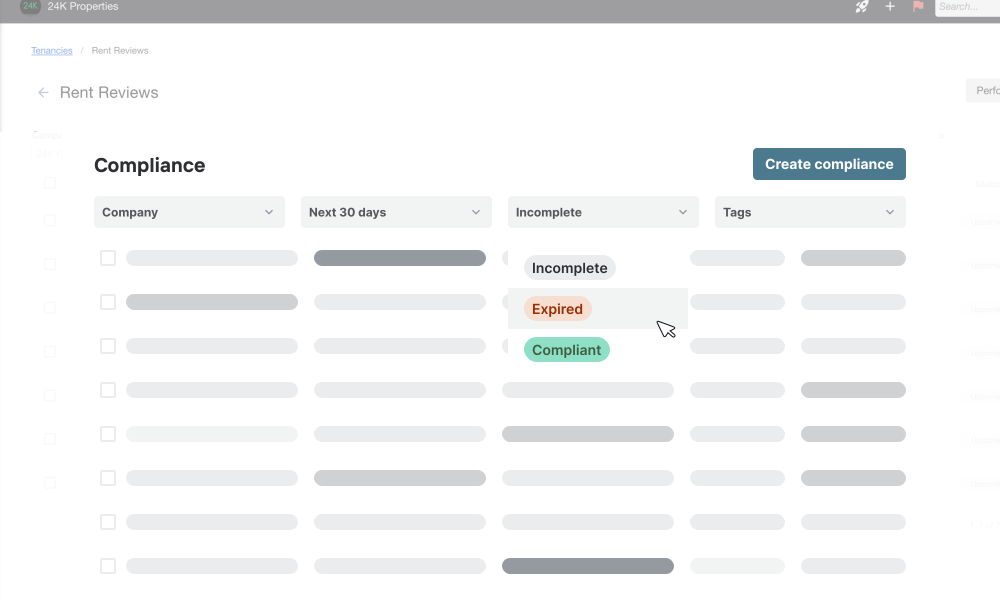
Effective compliance management requires full transparency of compliance statuses across your portfolio. The software should provide compliance status, upcoming deadlines, and completed or incomplete tasks.

What support and training should the vendor offer?

Good customer support and training resources are essential for successful software implementation. Check if the vendor offers comprehensive onboarding, training sessions, and ongoing support. Access to a knowledgeable support team can make a significant difference in your ability to use the software effectively.

How do you compare costs and value?

While cost should not be the sole factor in your decision, it is important to compare the pricing of different solutions and assess the value they offer. Choosing the right property compliance software can transform your compliance management, making it more efficient, accurate, and stress-free.

Which property compliance platforms perform well on these 10 evaluation criteria?

Mapping the 10 evaluation criteria to the leading platforms:

Criterion Re-Leased MRI Software Yardi Voyager AppFolio Buildium
Needs fit (commercial) High High (enterprise) High (enterprise) Limited Limited
Feature completeness High Highest (enterprise) High Moderate Moderate
Ease of use High (modern UX) Lower (steep learning curve) Lower (dated UX) High High
Customisable compliance High (custom categories) Very high High Limited Limited
Integration depth Two-way (Xero, QBO, NetSuite, Sage Intacct) Enterprise (29+ integrations) Internal accounting Limited Limited
Security / data protection SOC 2, ISO 27001 SOC 2 SOC 2 SOC 2 SOC 2
Mobile accessibility Native iOS / Android apps Mobile via web Mobile via web Native apps Native apps
Live compliance monitoring Yes Yes Yes Limited Limited
Support and training Mid-market white-glove Enterprise PM Enterprise PM Tier-based Tier-based
Total cost of ownership Quote-based $5K-$10K+ implementation $25K-$40K+ year $12K-$30K year $62-$400 / month

Verdict: For mid-market commercial property managers, Re-Leased and Yardi Voyager (enterprise) are the strongest matches across all 10 criteria. AppFolio and Buildium are better for residential-led portfolios but lack the customisable compliance category depth commercial portfolios need. MRI is the enterprise benchmark but carries implementation cost and complexity that puts it out of reach for many mid-market commercial operators.

Compliance Hub_Overview

Property Compliance Hub

At Re-Leased, we understand the importance of reliable compliance management, which is why we developed the Property Compliance Hub. We invite you to explore our solution and see how it can simplify your compliance processes.

Frequently Asked Questions

What is property compliance software?
Property compliance software tracks recurring regulatory and lease obligations -- statutory inspections, certifications, accessibility, fire / life-safety, energy compliance, lease-specific commitments -- against deadlines with automated alerts, escalation workflows, and documented audit trails. It's the operational layer that ensures property managers stay on top of compliance without manual spreadsheet tracking.
How much does property compliance software cost?
Costs vary widely by platform and portfolio size. Entry-level residential PM platforms (Buildium, AppFolio) run $62-$400/month or $12K-$30K/year. Commercial-first platforms (Re-Leased, Yardi Voyager Commercial) are quote-based, typically $5K-$25K+ per year depending on portfolio size and modules. Enterprise platforms (MRI Software) run $25K-$40K+ per year plus implementation. Total cost of ownership includes implementation, training, integrations, and ongoing support.
What's the difference between a property management platform and dedicated compliance software?
A property management platform handles the full lease-to-cash workflow (lease admin, rent, maintenance, accounting); compliance is one module within it. Dedicated compliance software focuses solely on tracking compliance obligations -- often used by property owners with multiple PM platforms or by managing agents with mixed-vendor portfolios. For most commercial operators, the property-management-platform-with-compliance-module approach is simpler and lower-cost.
How long does it take to roll out property compliance software?
Implementation timelines depend on platform and portfolio scope. Mid-market commercial implementations typically run 6-12 weeks from contract to go-live. Enterprise implementations (MRI, Yardi Voyager) run 3-12 months. The longest line items are typically data migration (lease documents, historical compliance records) and team training, not platform configuration.
Does property compliance software integrate with property management and accounting systems?
The strongest commercial platforms (Re-Leased, MRI, Yardi) integrate compliance management with lease administration and accounting natively -- meaning compliance events tie to specific leases and properties, and remedy costs post to the accounting ledger automatically. Standalone compliance tools require manual data movement between systems -- usable but operationally fragile.

About the Author

Image from iOS-3Dulan Perera
Director, Growth


Dulan combines strategic marketing expertise with deep knowledge of commercial real estate (CRE) to drive meaningful growth across the industry. His focus is on connecting property professionals with insights that matter, spanning compliance, financial operations, property management, stakeholder relationships, and the evolving role of technology and AI. His goal: help real estate businesses scale smarter in a digital-first world.

More Resources

more definitions

More Definitions

tools and templates

Tools and Templates

Let’s get started!

See how Re-Leased supports lease administration today.